From reactive capture to visual art direction
There was a time, and I say this with the honesty of someone who no longer feels shame, when my camera was an extension of my own reflection. I wasn’t looking at the scene. I was capturing it. I was a sort of predator of moments, always with my finger on the shutter, searching for that moment of grace, that perfect blur, or that light that would make me feel like I had achieved something. It was reactive photography. If the light arrived, I shot. If the subject moved, I tried to follow.
Today, looking back, I realize I wasn’t doing photography. I was just taking inventory of what already existed.
The change wasn’t an epiphany on a Monday morning. There was no bearded master emerging from the shadows of a studio to tell me the truth. It was a slow process of frustration, of looking at my own archives months later and feeling that, although the images were technically flawless, they were empty. Like catalogue photos. Pretty, sharp, but hollow. Without that feeling that someone had been there, not just to press a button, but to decide where the light ended and the shadow began.
The error of the obsession with sharpness
It has happened to all of us. We obsess over gear. The latest sensor, the lens with the gold star, the noise control that feels like black magic. We convince ourselves that if the image is sharp enough, the story will be strong enough. That is a lie. Sharpness is a technical condition, not a language.
I remember a portrait session years ago. I had equipment that would seem like a toy to me today, but at the time, I felt invincible. I was so focused on the technique that I realized too late that the light was dying. The late afternoon light, that light with an almost tactile quality, was escaping through the window we had left ajar. When I finally stopped to look at the result, I found a perfect image, yes, but a dead one. The subject was there, but the atmosphere had stayed outside the shot.
That day I understood that light is not something you use. It is something you build with.
Light as raw material and not as illumination
When you start talking about the architecture of light, the word architecture is key. We aren’t talking about illuminating an object so it can be seen, but about using light to create volume, to define spaces, to suggest what we are not showing.
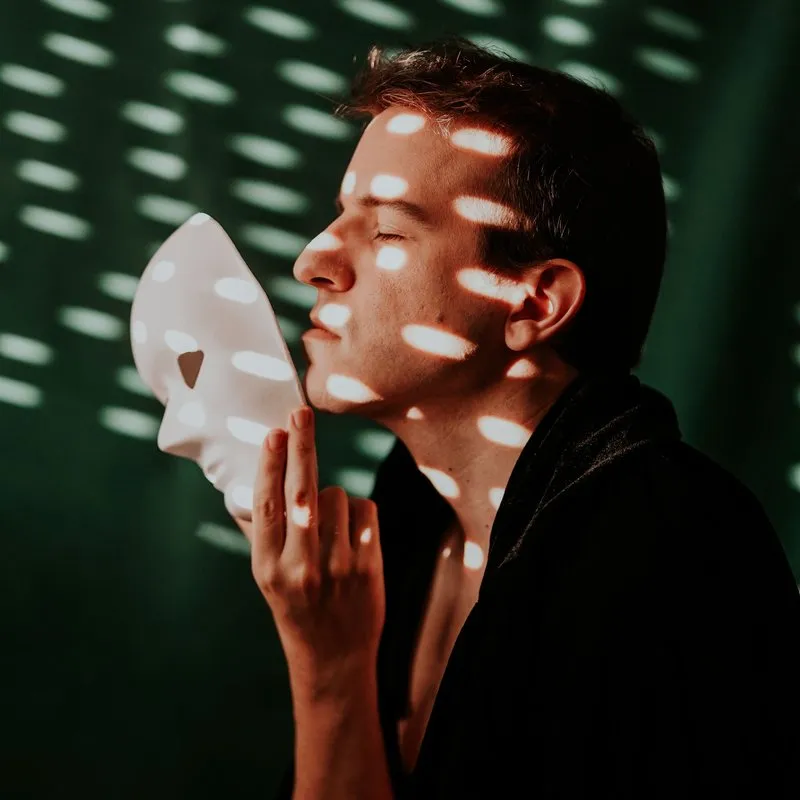
Learning to see means understanding that shadow carries as much weight as light. In art direction, this is what separates a good photographer from a visual director. A photographer sees a face. A director sees how the area of penumbra beneath the jawline can separate the subject from the background and create a narrative of mystery.
I learned that light has texture. There are lights that are like velvet, soft, enveloping, which hide imperfections and create an atmosphere of nostalgia or comfort. And there are lights that are like broken glass, harsh, direct, which permit nothing and force you to face the rawness of reality. Learning to choose which of these two tools you need for each story and knowing when not to use either is what truly allows you to start drawing with the camera.
The grammar of shadows
If light is what allows us to see, shadow is what allows us to feel. It is a truth as old as photography itself, but we forget it when we are too busy adjusting the ISO. We fear the black. We fear that void where there is no information, because the technical training we have been given tells us that a lack of detail is an error. An error. A lack of detail is, often, the highest point of expression.
In my early years as an art director, I tried to make everything legible. I wanted every texture of the clothing, every detail of the set, and every expression of the model to be there, exposed, clear, almost insulting in its clarity. It was a technical arrogance that left nothing to the imagination. And what you do not leave to the imagination, you do not leave to the viewer.
Shadow is the space for the viewer to work. It is where the mind completes the form. A well-placed shadow over an eye can transform a portrait from a simple close-up into a story of introspection or of threat. A shadow that devours part of a landscape can generate a sense of vastness or of claustrophobia. Learning the grammar of shadow is not learning to darken the photo, it is learning to use the void as a compositional element with as much weight as a solid object.
Sometimes, the best accessory on a set is not a new lamp or an expensive reflector, but simply knowing where to stop illuminating.
The discipline of waiting
There is a part of photography that no one tells you about in Instagram courses. The boring part. The part where nothing happens. The part where you are there, with the equipment set up, the light at its optimal point, the model ready, and you simply wait.
This sounds romantic or perhaps very professional, but the reality is that it is tedious. It is a discipline of endurance. You have to learn to resist the temptation to shoot too soon. You have to learn to observe how the atmosphere of the place changes, how the light shifts by just a few millimeters, how the model begins to relax and the tension of the set transforms into something more authentic.
I remember an outdoor shoot for a jewelry campaign. The sun was at that exact point in the afternoon that everyone seeks. The team was all ready, the reflectors positioned to soften the shadows, and I was there, holding back the urge to hit the shutter. I was waiting for a cloud to pass, for the wind to move a branch slightly, for something to break the static perfection. It was forty minutes of pure boredom, of looking at the clock, of checking the gear for the fifth time. But when that small change occurred, when the light stopped being a perfect studio light and became a light with character, that was the only shot that mattered.
That discipline, the one of not betraying the scene through the anxiety of completing the work, is what separates the technician from the artist. The technician finishes the work when the shot list is complete. The artist finishes when the light has been imprinted on the retina in a way that cannot be repeated.
Conclusion: The eye as the final tool
In the end, this whole journey regarding architecture, shadow, and waiting boils down to a single idea. The camera is secondary. You might use a collector’s Leica or a modern iPhone, but if you have not learned to see the structure of the light before touching the button, you are only making visual noise.
Art direction and auteur photography do not consist of adding layers of complexity, but in knowing how to peel away the layers of the unnecessary to find the essence. It is about building an image that is not just pretty, but has a solid structure, that has weight, that has that ambiguity that only well-managed shadow and light can offer.
If you want to improve your work, stop looking at editing tutorials. Stop obsessing over sensor resolution. Start looking at how light hits a surface, how shadow projects onto a face and, above all, learn to stay still, in silence, waiting for the scene to speak to you. Because when you learn to see, you no longer need to shoot so much. You just need to shoot well.