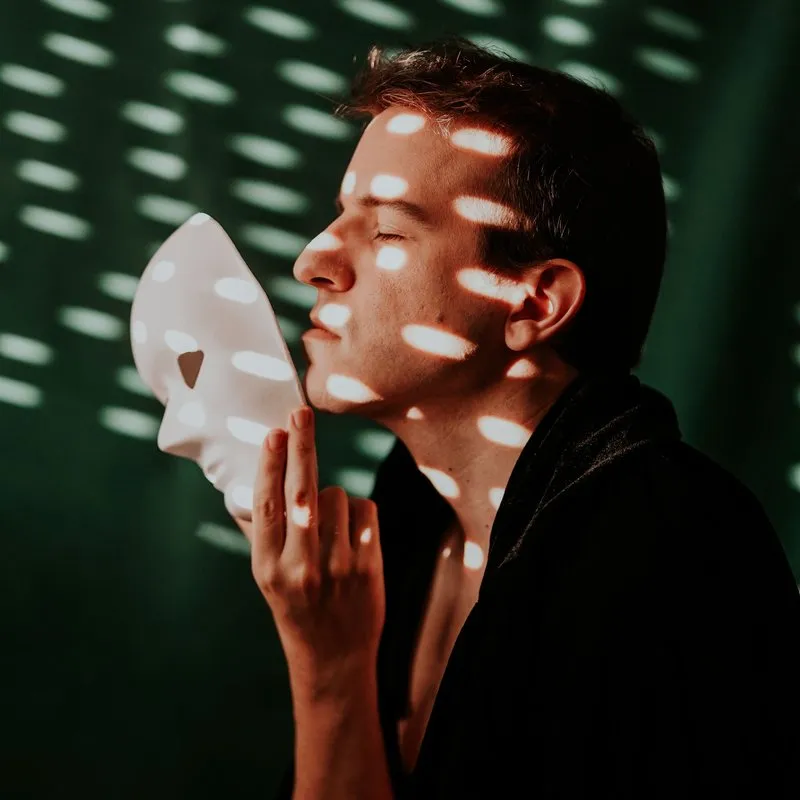
The mirror does not lie. Or at least, not in the way we usually believe.
We grow up learning to decorate the surface. We choose the angle that favors us, the light that erases dark circles, the gesture that hides insecurity. We become specialists in editing our own image, a silent, daily, almost invisible job. We look at the glass and seek the version that the world expects of us. We build a facade of symmetries and textureless skins, and we polish every detail so that no one notices the cracks. But this editing comes at a cost. By polishing the surface so much, we end up losing the depth. We are left with a brilliant portrait, but an empty one.
The camera, when it becomes an exercise in honesty, proposes a different process. It does not seek the retouched version, nor the technical perfection that ignores humanity. It seeks the truth that remains when the artifice breaks, when the light ceases to be decorative and becomes revealing.
An eye trapped in the crack
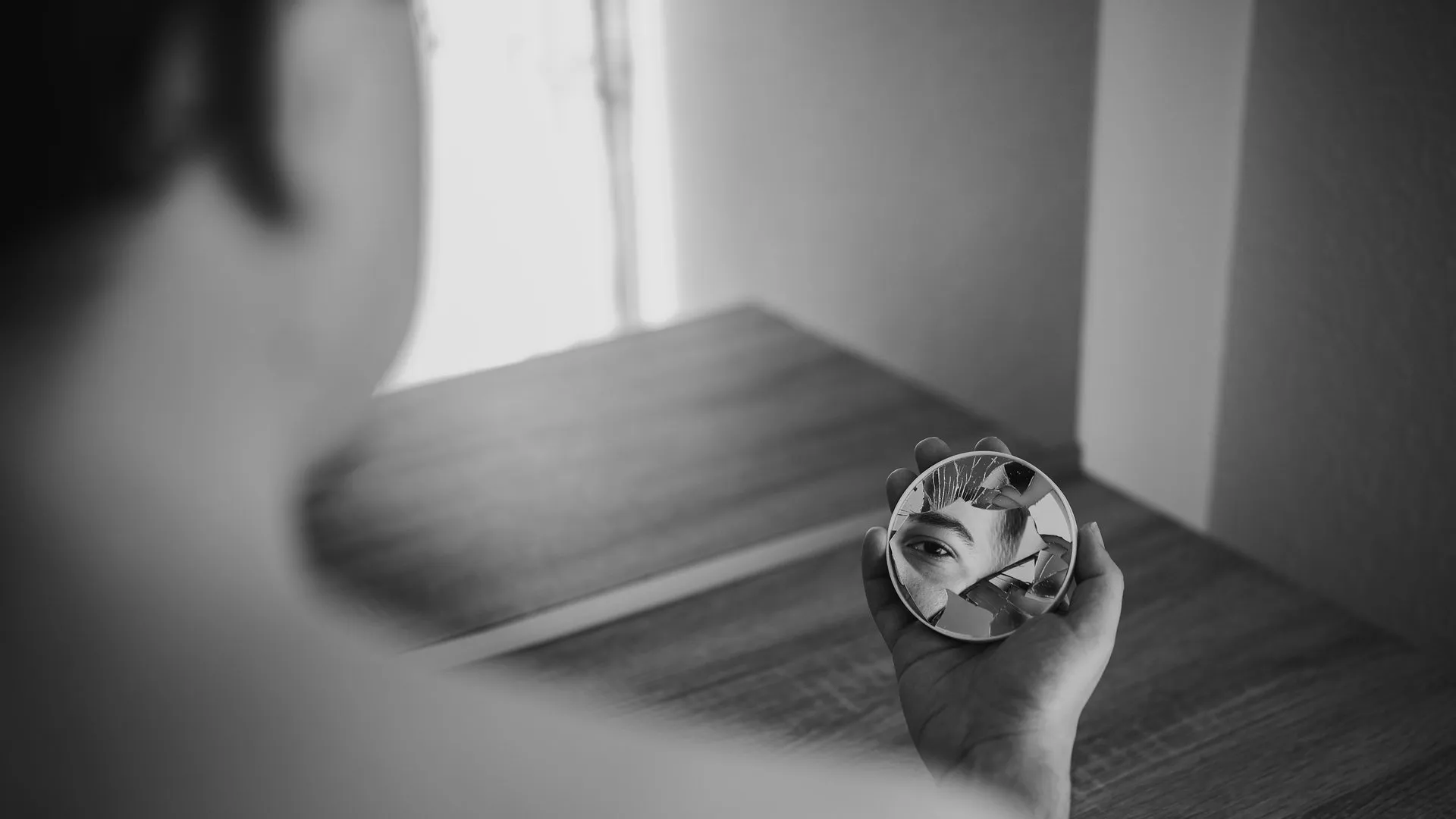
Self-portrait with a broken mirror, 2026. Photograph by Vicin Ruiz.
This is the first encounter with disaster. A broken mirror, a fragmented reflection. There is no complete image here that I can ignore, no whole face to pretend that everything is fine. There is only one eye, a part of me, trapped in a crack in the glass. It is uncomfortable and raw, but real. The backlight from the window barely outlines the contour of my back, but the fragment of the mirror forces me to face what remains. That eye looking at me from the broken glass knows nothing of filters. It has no obligation to be beautiful according to fashion magazine standards. It only needs to observe.
Vanity and self-esteem
We often confuse self-esteem with vanity, a common and almost inevitable mistake. Vanity is the care of the mask, the effort to keep the facade intact, to ensure that the light always falls in the right place to hide what we are ashamed of. Vanity is built outward, in dialogue with the spectator and their judgment. Self-esteem, on the other hand, is an inward process. It is the ability to hold the gaze before what we do not like about ourselves, the courage to look at the fragment, the broken part, that shadow the window light tries to soften without success.
There is nothing of vanity in this self-portrait. It does not seek praise, it seeks recognition. Many see the self-portrait as an act of narcissism, as a misguided exercise in self-love. They think a photographer looking at themselves is someone seeking a pedestal. But when the camera is used as a mirror, the act is one of humility. It is accepting that we are a collection of parts, some luminous and others dark. This is who I am, with my cracks and the parts that do not fit. An act of surrender to one’s own truth.
The light that leaves room for doubt
I have learned that the most powerful light does not illuminate everything. It leaves room for uncertainty, it creates chiaroscuro and lets doubt breathe. Photographing the self-portrait is an act of presence. It is learning to inhabit the body we have, not the body we wish to have.
A map of reflections
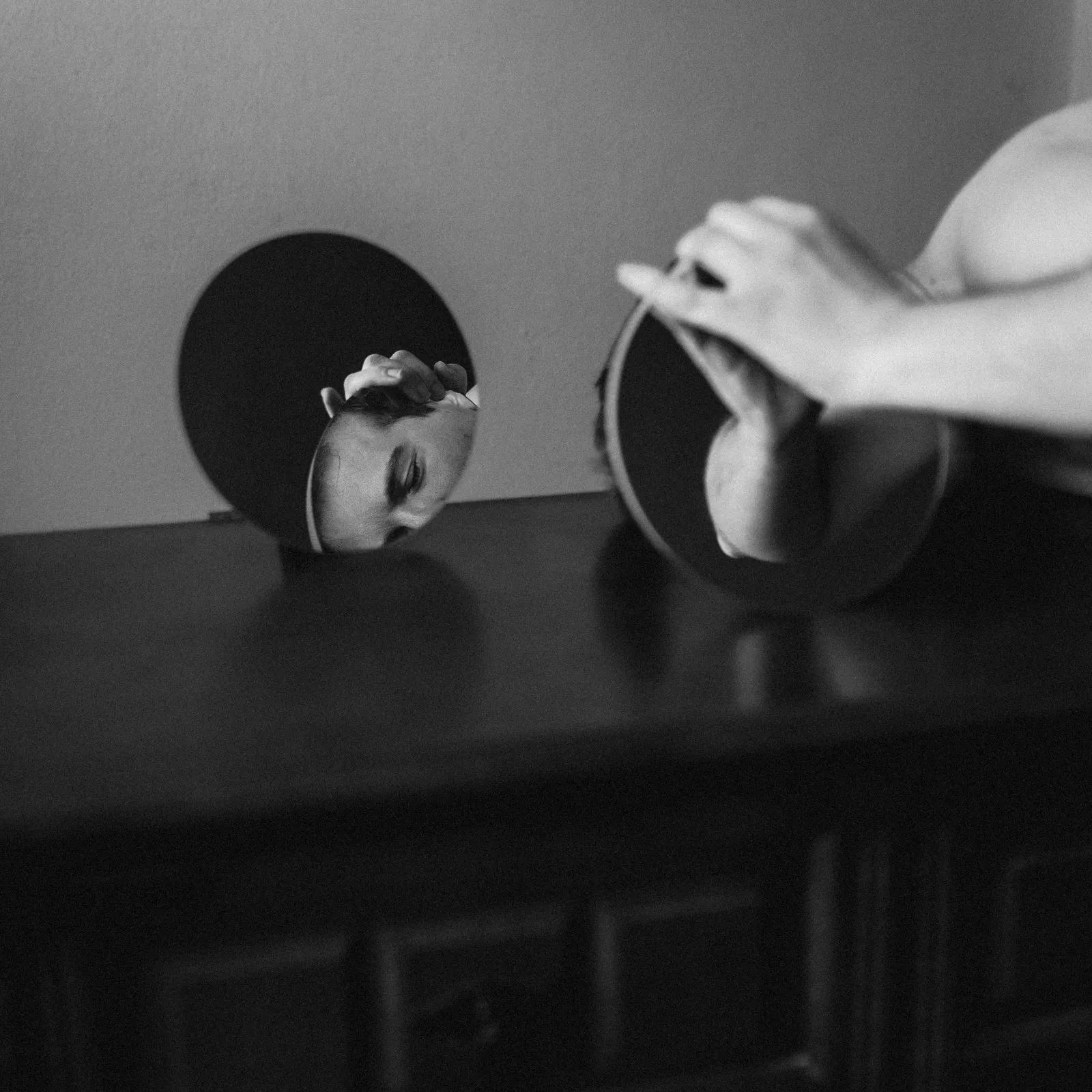
Self-portrait with two mirrors, 2026. Photograph by Vicin Ruiz.
Here the face is lost again. It is divided into two mirrors, into round shapes that return to me a multiple, incomplete identity. The torso is fragmented before the duality of the reflection. There is no clear center, no perfect unity. There is only presence, scattered in pieces of glass. The face breaks, duplicates, becomes strange. Looking at myself like this, I cease to be a single entity and become a map of reflections.
Grain as the texture of life
The photographic technique itself becomes a metaphor for this process of acceptance. I think of the film grain, that visual noise we try so hard to eliminate today with the cleanest digital sensors. Grain is the texture of life, the imperfection that gives body to the image. Just as in us, it keeps the image from being flat, a surface without a soul. A too perfect, too sharp focus can result in sterility. Sometimes we need the blur, the lack of sharpness, to find the essence of what we are feeling. Light, framing and depth of field work together to remind us that beauty lives in the atmosphere of our own existence, not in absolute clarity.
Against the monolithic image
Today’s society asks us for a monolithic, impeccable, seamless image. We are required to be a well-exposed photograph, without noise or grain, without focus errors. We live in the era of permanent filters, of porcelain skin that erases the history of every wrinkle and every scar. We are asked to be a showcase of unattainable perfection. But this demand is a form of violence against our own nature. It forces us to reject our humanity and our fragility.
The camera works like that honest mirror that breaks the social imposition. It returns to me the texture of my skin, the hardness of my expression, the fatigue of my gaze. It does not tell me how I should look to fit into someone’s feed. It tells me how I am. It returns to me the weight of the years and the mark of experiences. And in that recognition there is a profound liberation. If I accept the fragment, I stop fighting against the whole. If I accept the focus error, I stop pretending that my life is a straight and perfect line.
Self-esteem is born in disorder
It is not in the perfection of the reflection, nor in the absence of defects. It is in the acceptance of disorder, in the moment we stop trying to repair the mirror and start learning to look through its cracks. To understand that even the broken mirror, with all its visual violence, shows something the smooth and polished surface never could. The eye looking at me from the crack, the face divided in round mirrors, both share a truth: the only gaze that truly matters is the one that does not need permission to exist. Holding the gaze before ourselves is perhaps the most revolutionary act we can perform.