The Weight of the Answer
There is a question that carries the entire weight of Daesung Lee’s project. It is a question from a son, a question seeking the meaning of existence on the threshold of loss. “Mom, if reincarnation existed, what would you want to be in your next life?”. His mother’s answer is a blunt, absolute refusal. “I don’t want to be reborn.”
That sentence is the axis of everything we see in his series Nirvana. As a photographer, I find it fascinating how Lee takes that rejection of continuity, that exhaustion from a life cycle that has been, for many women of her generation, a cycle of silence and duty under Confucianism, and transforms it into something luminous. He is not looking for tragedy. He is looking for transcendence through play.
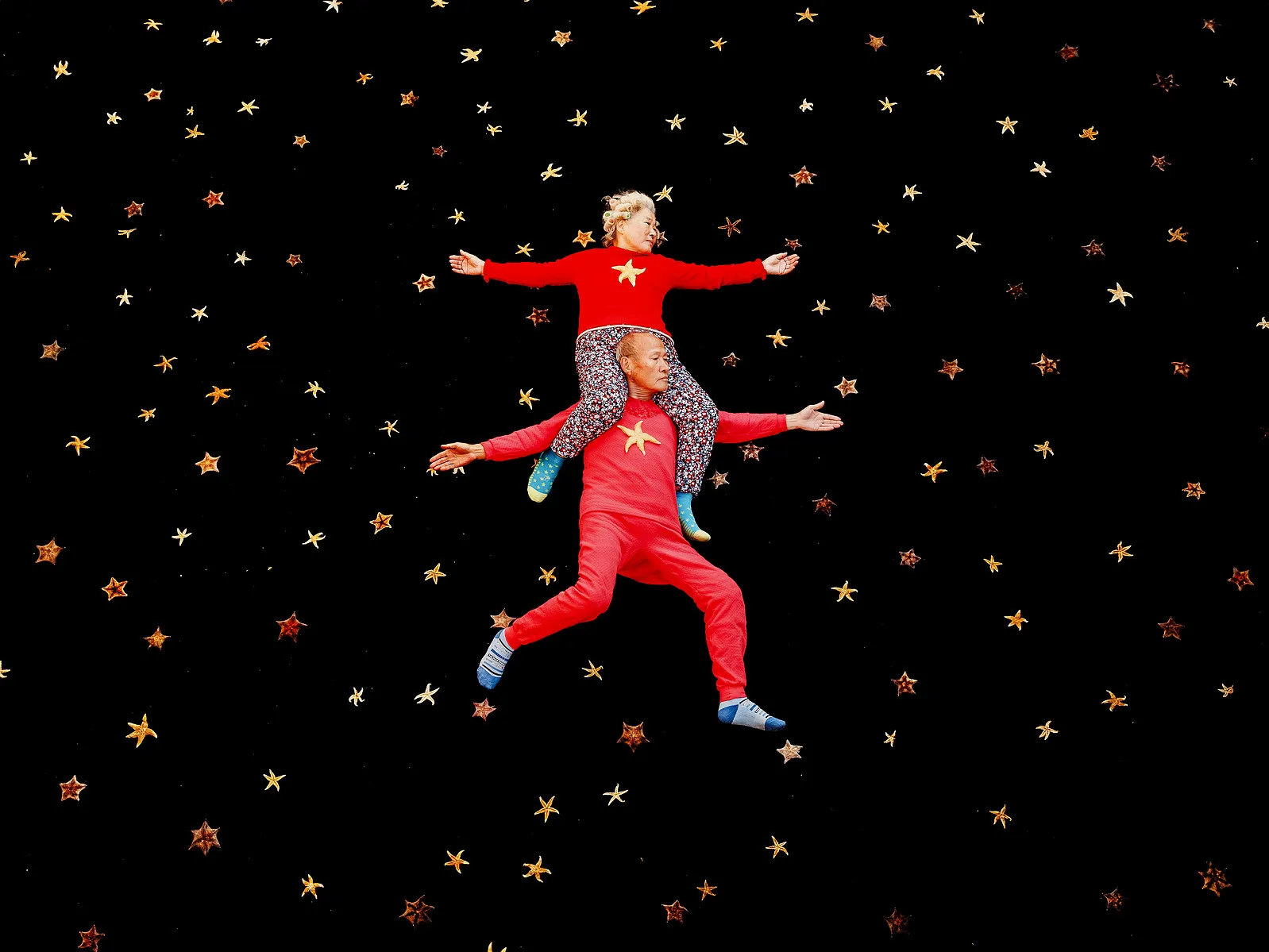
His parents, turned into stars. Photograph: Daesung Lee, Nirvana series (© Daesung Lee).
The Mother as a Collaborator
The first thing that hits you when looking at Daesung Lee’s images is that you are not witnessing a photographer “using” a subject. There is no trace of that gaze seeking the perfect shot at the expense of the person’s dignity. On the contrary, Lee describes his process as something similar to children playing dress-up. It is a work of total complicity.
Lee’s mother is not an object of study. She is a creative collaborator. She participates in the construction of this surrealist universe. This is a lesson in humility for anyone working in portraiture. The agency of the subject is not something granted to them. It is something built together in the studio or in the courtyard of a home. By elevating her as an active subject, Lee subverts decades of a history where the Korean woman of the 1970s was, above all, an invisible pillar of the family structure.
Starfish and Divine Hands
The images are visually striking because they blend the mundane with the mythical in an incredibly organic way. There is one photograph that has left me thinking for days. In it, his mother seems to float among stars. But these are not stars from the sky. They are starfish collected by local fishermen from their nets. The contrast between the organic texture of the starfish and the dark background creates a dreamlike atmosphere of pure visual poetry.
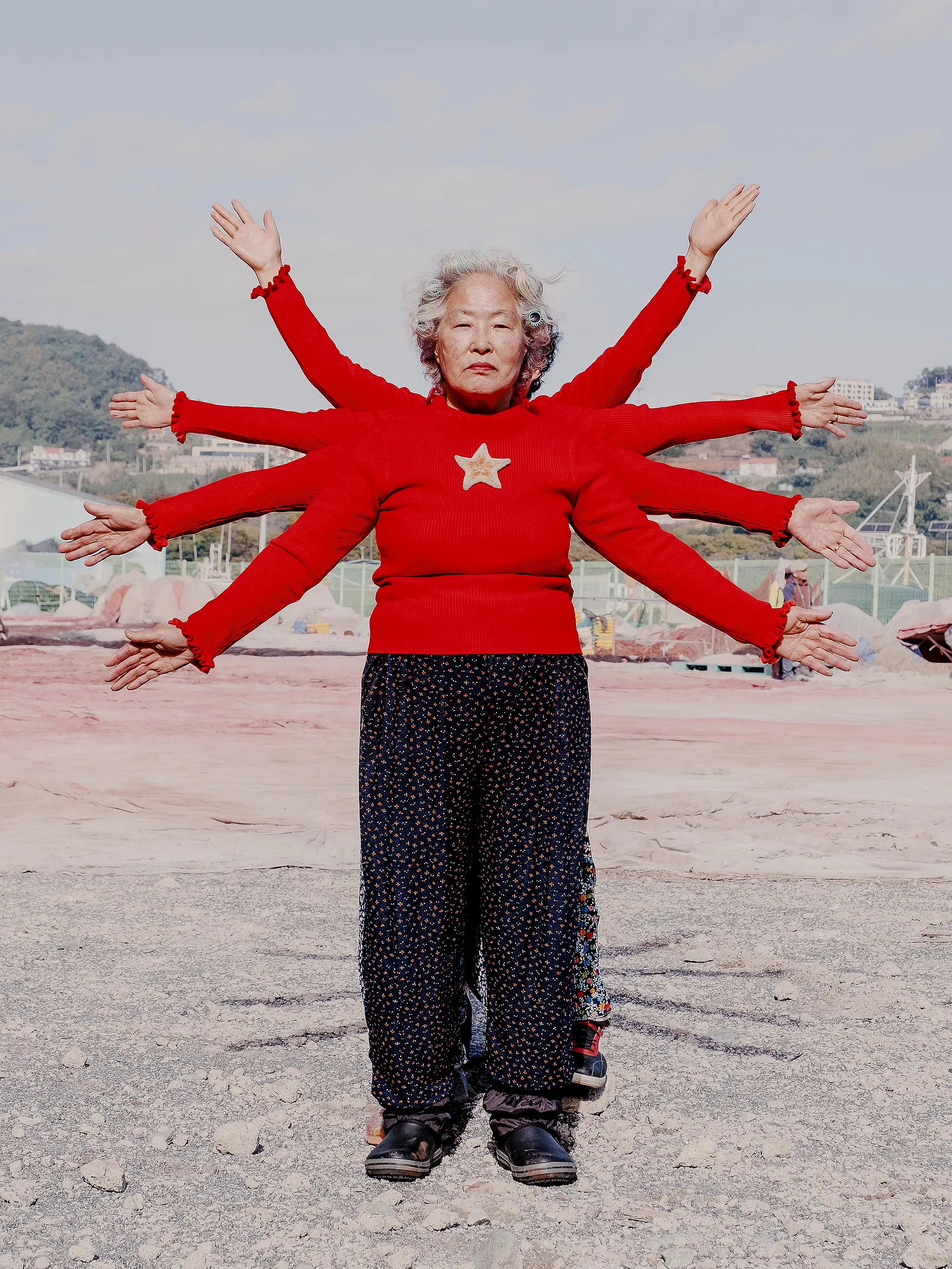
Eight arms for an endless workload. Photograph: Daesung Lee, Nirvana series (© Daesung Lee).
In another piece, Lee turns to religious iconography to speak of the burden of womanhood. His mother appears with multiple arms, evoking the bodhisattva Guanyin. Lee’s comment is devastating: “even if she had ten hands, it wouldn’t be enough”. It is a visual metaphor for the unending labor, the management of three generations living under one roof, and the emotional weight that was silenced to maintain domestic harmony. It is a use of surrealism that is not gratuitous, but rather the only way to make the invisible visible.
The Red of Memory and the Coldness of Feet
There are details in these photographs that force you to pause. They are not just aesthetic compositions. They are narratives of identity. The use of the color red is constant. It is not an arbitrary choice. It is the color of thermal underwear, a color linked to Korean tradition when a son receives his first paycheck. It is a color that speaks of care, family success, and survival.
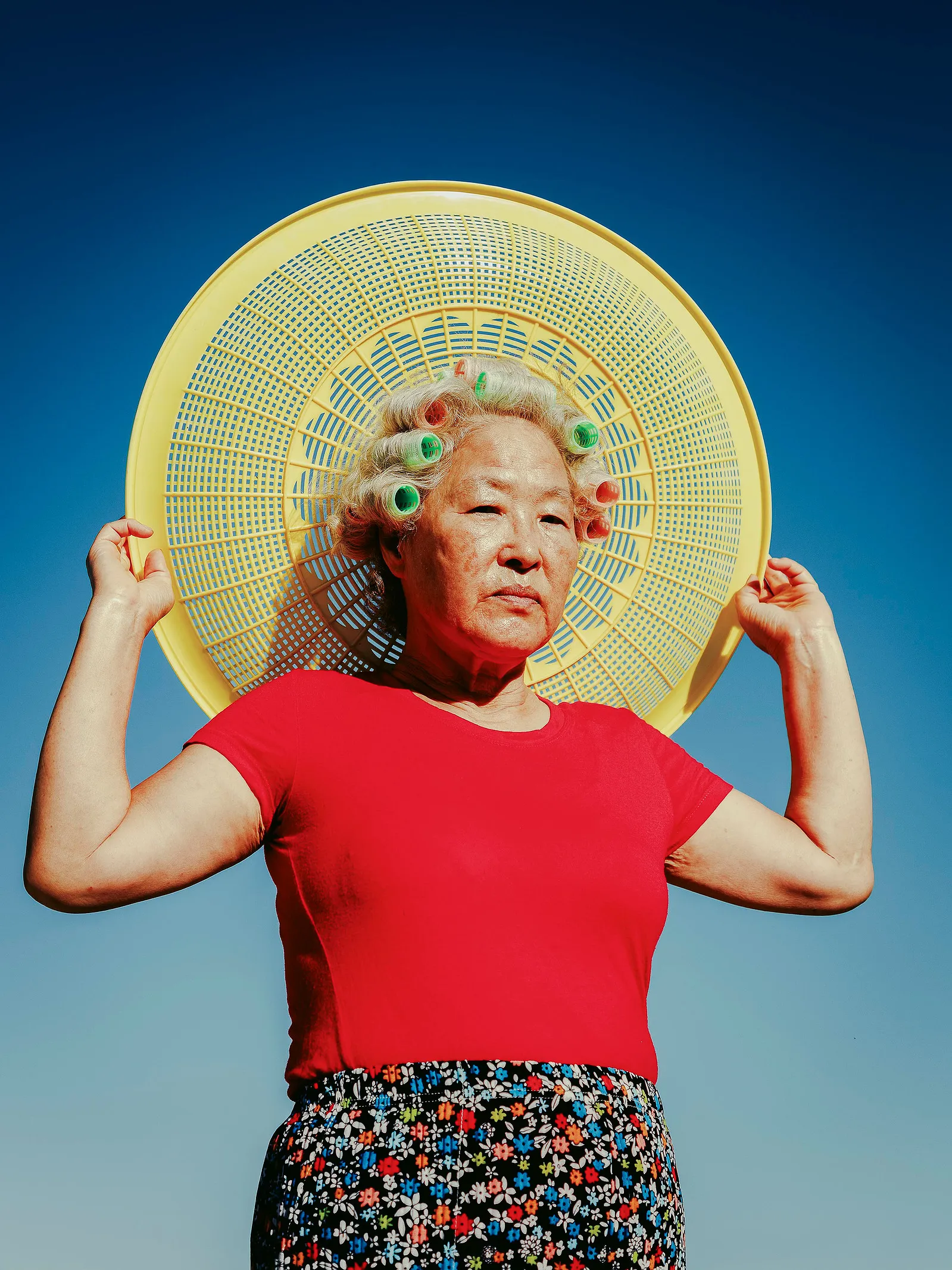
The curled hair of the ajumma and a basket as a crown. Photograph: Daesung Lee, Nirvana series (© Daesung Lee).
And then there are the feet. Lee photographs his mother wearing transparent pediluvium shoes. He tells us that her feet have always been cold since she gave birth to him at home. That detail, almost clinical yet profoundly intimate, grounds us in the physical reality of the woman. It reminds us that behind the eight-armed goddess or the woman flying through stars, there is a body that feels, that suffers the weather, and that has its own biological history. It is the perfect balance between the mythical and the earthly.
Humor as a Tool for Grief
Daesung Lee has covered subjects of extreme hardship, from the Bosnian War to climate change. That is why I find his turn toward this light, playful approach so valuable. We often think that to discuss profound themes like the end of life or the weight of patriarchy, we need somber tones and heavy compositions.
Lee proves the opposite. Humor and playfulness are tools of resistance. By photographing his mother with comedically long legs hanging from a roof, or wearing star-patterned sweaters, he is creating a shared memory that is sweet rather than bitter. He is preparing the ground for farewell. He is not documenting a death. He is celebrating an existence.
For those of us who work with imagery, Nirvana is a reminder that the most powerful portrait is not the one that captures a face, but the one that captures a shared truth between two people who recognize each other.
All images are works by Daesung Lee (© Daesung Lee), from the Nirvana series, reproduced for the purposes of criticism and review. You can see the full project at daesunglee.com/nirvana. If Daesung Lee wishes me to remove any image, he only needs to ask.